Introduction
Walking up to someone you don't know can feel surprisingly difficult. Your mind races. You think about what to say. You worry about making a bad impression. You fear the conversation might get awkward. The truth is, almost everyone experiences this feeling at some point.
The good news is that talking to strangers isn't a talent you're born with—it's a skill that anyone can learn. Like riding a bike or learning a new language, it becomes easier with practice. The more conversations you have, the more confident and natural you become.
Learning to talk to strangers is a key social skill. It helps you make new friends. It boosts your communication skills. Plus, it grows your professional network. Plus, it makes meeting new people feel easier.
In this guide, you'll learn why talking to strangers can be awkward. You'll find ways to overcome that fear and practical tips for starting conversations. We'll also cover common mistakes to avoid and how to connect safely, both in person and online.
By the end, you'll feel confident starting conversations on your own. No more waiting for others to make the first move.
Why Talking to Strangers Feels So Difficult?
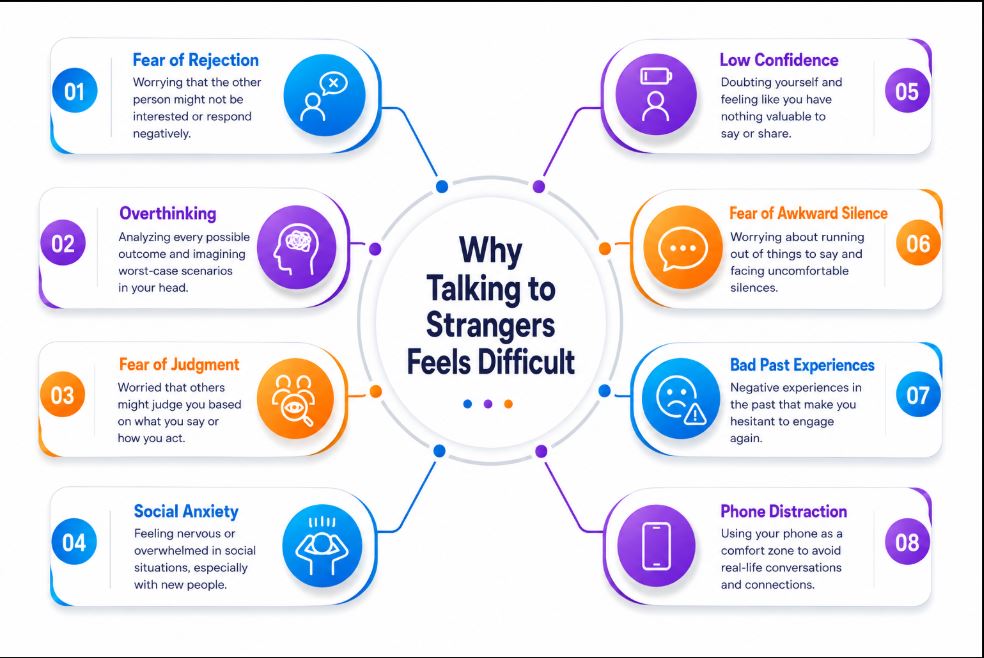
If you've ever stood in a room full of people and wanted to start a conversation but couldn't, you're far from alone. Many people believe they are shy or struggle in social situations. But psychology shows there's more to it.
Our brains wire themselves to steer clear of uncertain situations. When you’re about to talk to someone new, your brain has little info on how they’ll react. That uncertainty often triggers nervousness, even though there is usually no real danger.
Another common reason is the fear of rejection. People often imagine worst-case scenarios before anything has even happened.
You might think:
- "What if they ignore me?"
- "What if I say something embarrassing?"
- "What if they don't want to talk?"
In reality, these situations happen far less often than we imagine. Most people are polite, and many are as nervous about meeting someone new as you are.
Social media has also changed the way we communicate. More conversations are happening on screens. This means we have fewer chances to practice face-to-face interaction. Even confident people can feel uneasy when talking to strangers in person.
Feeling nervous is normal. It doesn’t mean you’re making a mistake. It means you're leaving your comfort zone. That's where personal growth starts.
The Surprising Benefits of Talking to Strangers:
Many people skip chats with strangers. They don’t see how much they can gain. A quick chat, a few minutes long, can boost your confidence. It can also broaden your view and, at times, change your life path.
You Become More Confident

Confidence doesn't appear overnight. It grows through experience.
Every chat teaches you something fresh. You learn about communication, body language, and how to react in various situations. The more often you speak with new people, the less intimidating it becomes.
You Improve Your Communication Skills
Chatting with various personalities makes you a better listener. It helps you plan thoughtful questions and express your ideas with clarity.
These skills matter in daily life. They help in job interviews, business meetings, presentations, and personal relationships.
You Discover New Perspectives
Every person has a different background, culture, and life experience.
Talking to someone from a different country or community can open your mind to new ideas. Even short conversations often leave you with a fresh way of thinking.
You Can Make Meaningful Friendships
Many long-lasting friendships begin with a simple hello.
You might be traveling, attending an event, studying, or chatting online. You never know which conversation could spark a real connection.
After all, every close friend was once a stranger.
You Reduce Feelings of Loneliness
Meaningful conversations help people feel connected.
A quick chat with someone new can boost your mood. It shows that real people are out there. They want to listen, share stories, and exchange ideas.
Positive social interactions, even small ones, can boost emotional well-being over time.
You Learn About Different Cultures
Talking to people worldwide helps you learn. You can discover new traditions, languages, and views—all from home.
It's one of the easiest ways to expand your understanding of the world.
You Create Unexpected Opportunities
Many opportunities begin with a conversation.
New friendships.
Business partnerships.
Travel recommendations.
Language exchange partners.
Career advice.
Sometimes all it takes is saying hello.
The 10 Biggest Mistakes People Make When Talking to Strangers:
Talking to strangers isn’t hard because people can’t talk. It’s tough because we often overthink before the conversation starts. The good news is that most awkward interactions stem from common mistakes. You can fix them without difficulty once you spot them.
1. Waiting for the "Perfect" Moment
Many people don’t start conversations because they wait for the perfect moment.
They promise to say hello when the other is free, the timing is right, or they think of something fun.
The truth is that perfect moment rarely arrives.
Most conversations start with something easy. It could be a smile, a greeting, or a comment about your surroundings. The sooner you stop searching for the perfect opening, the easier conversations become.
2. Thinking You Need an Amazing Opening Line
Many people believe they need a clever joke or an unforgettable first sentence.
You don't.
Most successful conversations begin with ordinary words.
A simple "Hi, how's your day going?" often works better than a rehearsed pickup line or complicated introduction.
People usually remember how you made them feel, not the exact words you used.
3. Talking Too Much About Yourself
When people feel nervous, they often fill every second with words.
They turn the conversation into a monologue without realizing it.
Balanced conversations promote health. Share your own experiences, but also ask questions and give the other person room to speak.
People enjoy conversations where they feel heard.
4. Asking Too Many Questions
The opposite problem also happens.
Some people ask question after question without sharing anything about themselves.
It starts to feel like an interview instead of a natural conversation.
A better approach is to answer your own questions too.
For example:
Instead of asking:
"Where are you from?"
You could say:
"I'm from Pakistan. What about you?"
Small details encourage the other person to open up as well.
5. Being Afraid of Silence
Many people panic the moment there's a few seconds of silence.
Silence isn't failure.
In fact, short pauses make conversations feel more relaxed and natural.
Don't rush to fill every second.
Sometimes a smile is enough before asking your next question.
6. Trying to Impress Instead of Connect
People often think they need to sound funny, intelligent, successful, or interesting.
Instead, focus on being curious.
The goal isn't to impress strangers.
The goal is to understand them.
People enjoy conversations where someone demonstrates genuine interest in their identity.
7. Ignoring Body Language
Words are only part of communication.
Your posture, eye contact, facial expressions, and tone of voice all shape how people react.
Simple habits make a huge difference:
- Smile with ease.
- Stand with your arms at your sides and maintain a confident posture.
- Maintain comfortable eye contact.
- Speak with clarity and take your time.
- Face the person you're talking to.
Friendly body language often starts the conversation before you even say a word.
8. Assuming People Don't Want to Talk
This is one of the biggest mental barriers.
Most people aren't thinking:
"I hope nobody talks to me today."
In fact, many people enjoy friendly conversations, especially when they're respectful and natural.
Some will be busy.
Some people will not show interest.
That's completely normal.
Don't let a few unsuccessful conversations stop you from starting new ones.
9. Not possible to remove the adverb.
Confidence isn't built after one conversation.
It's built after twenty.
Or fifty.
Or one hundred.
Every conversation teaches you something.
Instead of judging yourself after one awkward moment, ask:
"What did I learn that I can do better next time?"
Small improvements lead to big confidence over time.
10. Forgetting That Every Friend Was Once a Stranger
This simple reminder changes everything.
Every close friendship...
Every business partner...
Every mentor...
Every relationship...
Started with two people who didn't know each other.
That first conversation is the toughest. But it opens the door to all future opportunities.
How to Start a Conversation With a Stranger (Step-by-Step):

The easiest conversations don't begin with perfect words. They begin with confidence, curiosity, and a simple greeting.
Here's a framework you can use almost anywhere.
Step 1: Notice Your Surroundings
The best conversation starters come from what's happening around you.
If you're at a coffee shop, comment on the menu.
If you're waiting for a bus, mention the weather or ask if the bus is usually on time.
If you're attending an event, ask what brought them there.
People find it much easier to respond when the topic feels natural.
Step 2: Start Small
You don't need to jump into deep conversations immediately.
Simple greetings work surprisingly well.
Examples include:
- "Hi, how's your day going?"
- "Have you been here before?"
- "That looks interesting—what are you reading?"
- "I like your shoes. Where did you get them?"
Simple beats complicated almost every time.
Step 3: Listen More Than You Speak
One of the easiest ways to become a better conversationalist is to become a better listener.
Listen to what the other person says. Don't think about your next sentence while they talk.
Good conversations grow naturally when people feel heard.
Step 4: Ask Open Questions
Questions that can only be answered with "yes" or "no" often end conversations quickly.
Instead, ask questions that encourage stories.
For example:
Instead of:
"Do you like traveling?"
Try:
"What's the best place you've ever visited?"
The second question invites a conversation instead of a one-word answer.
Step 5: End the Conversation Naturally
Not every conversation needs to last an hour.
Sometimes five enjoyable minutes are enough.
When it's time to leave, simply say something like:
"It was really nice talking with you. I hope you have a great day."
Ending conversations confidently is just as important as starting them.
50 Conversation Starters That Actually Work:
Many people find it hard to talk to strangers. They often don’t know what to say. The good news is that you don't need clever jokes or perfect lines to start a conversation. Great conversations usually start with simple questions. These invite others to share about themselves.
Here are conversation starters you can use in different situations.
Everyday Conversation Starters
- Hi! How's your day going so far?
- Have you been here before?
- What's been the best part of your day?
- Are you from around here?
- How's your week been?
- What do you usually do for fun?
- Have you watched any good movies recently?
- What's your favorite place to relax?
- Do you enjoy traveling?
- What's something you're looking forward to this month?
Questions That Keep the Conversation Going
Once someone answers your first question, don't immediately jump to another topic. Build on what they've already shared.
Instead of asking random questions, try follow-up questions like:
- Really? What made you choose that?
- How did you get into that?
- What happened next?
- Would you do it again?
- What do you enjoy most about it?
- How long have you been doing that?
- What's the funniest thing that's happened?
- Would you recommend it?
- What's your favorite part?
- What would you change?
People enjoy talking to someone who is genuinely interested in their story.
Conversation Starters for Online Chat
Chatting online can feel easier. You get more time to think before you reply.
Instead of sending messages like:
Hi
or
Hello
Try something more interesting.
Examples:
- If you could visit any country tomorrow, where would you go?
- What's something that always makes you laugh?
- What's your favorite way to spend a weekend?
- Have you learned anything new this week?
- What's the best meal you've ever had?
- If money wasn't a problem, what would you do every day?
- What's one hobby you'd love to start?
- Which movie have you watched more than once?
- Morning person or night owl?
- Coffee or tea?
These questions are simple, but they encourage real conversations instead of one-word replies.
Conversation Starters for Making New Friends
To build real friendships, focus on shared interests. Small talk isn’t as important.
You could ask:
- What hobbies do you enjoy most?
- What kind of music do you listen to?
- Do you play any games?
- What's your dream travel destination?
- What book changed your perspective?
- What's your favorite sport?
- What do you usually do after work or school?
- What's something you're passionate about?
- Do you enjoy learning languages?
- What's your biggest goal this year?
Friendships often begin when people discover something they have in common.
Funny Conversation Starters
Humor can make conversations feel relaxed—as long as it feels natural.
Here are a few lighthearted questions:
- If animals could talk, which one would be the funniest?
- What's the weirdest food you've ever tried?
- If you had a superpower for one day, what would you choose?
- What's your most embarrassing childhood memory?
- What's the funniest thing that's happened to you recently?
- Would you rather travel to the past or the future?
- What's one food you'll never eat again?
- If you could live anywhere in the world, where would it be?
- What's your guilty pleasure TV show?
- What's one thing everyone should try at least once?
Remember, the goal isn't to be a comedian. It's simply to create a relaxed atmosphere where conversation flows naturally.
How to Talk to Strangers Online?

Talking to strangers online is easy. It helps you meet people from different countries and cultures. You can quickly connect with others through online chat platforms. You can make friends, practice a new language, or have a fun chat—all in seconds.
Random chat platforms are different from social media. On social media, conversations often occur between people who know each other. But on random chat platforms, you meet someone completely new. Every conversation is different, which makes the experience exciting and unpredictable.
If you're new to online chatting, here are a few simple tips:
- Start with a friendly greeting instead of a single-word message.
- Be respectful and patient, even if the other person is different from you.
- Ask open-ended questions to keep the conversation moving.
- Listen as much as you speak.
- If the conversation isn't enjoyable, politely move on instead of arguing.
Many platforms today provide text, voice, and video chat. You can pick the communication style that feels best for you. Some people like to start with text before moving to voice or video. Others prefer to have face-to-face conversations right away.
TalkToStrangers.io offers an easy way to meet people globally. Connect instantly with anonymous text, voice, and video chat. No complicated registration is needed. Every connection begins with a simple hello. Whether you want a quick chat or lasting friendships, it all starts there.
Staying Safe While Talking to Strangers Online:
Meeting new people online should always be enjoyable, but it's important to stay safe. Here are some simple tips to help you have good conversations and keep your privacy safe.
Never Share Personal Information
Avoid sharing sensitive details such as:
- Your home address
- Phone number
- Passwords
- Banking information
- Government identification
- Workplace details
You can have meaningful conversations without revealing private information.
Trust Your Instincts
If someone makes you uncomfortable, stop talking to them. If they ask for personal info or act badly, end the conversation right away.
You never owe anyone your time.
Use Moderated Platforms
Choose platforms that actively moderate conversations and provide reporting or blocking features. These tools help create a safer environment for everyone.
Respect Others
Safety is a shared responsibility. Be kind to others. Avoid offensive words. Respect all cultures, opinions, and backgrounds.
Positive conversations begin with mutual respect.
Remember Your Goal
Have real conversations. You can make friends, practice a language, or just pass the time. Don't worry about impressing others.
The best connections happen naturally.
7 Simple Exercises to Become More Comfortable Talking to Strangers:
Like any skill, confidence grows through practice. Start with small challenges. They’ll help you step outside your comfort zone. Don’t wait until you feel totally ready.
Here are a few simple exercises you can try this week.
Exercise 1: Say Hello to Three People
Your goal isn't to have long conversations.
Simply greet three people during your day.
It could be:
- Your neighbor
- A cashier
- Someone at the gym
- A coworker
- A fellow student
This habit shows your brain that starting conversations isn't so scary.
Exercise 2: Ask One Genuine Question
Next time you're talking to someone, ask one question that shows genuine curiosity.
For example:
"What do you enjoy most about your job?"
or
"How did you get interested in that hobby?"
People usually appreciate someone who wants to learn about them.
Exercise 3: Practice Active Listening
Focus on really listening to what the other person is saying. Don’t worry about your next sentence.
Pay attention to:
- Their words
- Their tone
- Their emotions
- Their body language
Great conversationalists are usually great listeners first.
Exercise 4: Give One Honest Compliment
A sincere compliment is an easy way to create a positive interaction.
For example:
- "That's a great jacket."
- "You provided a clear explanation."
- "I like your positive attitude."
Keep it genuine and respectful.
Exercise 5: Spend Five Minutes Talking to Someone New
Try to have one conversation with a stranger, whether in person or online. Challenge yourself!
Don't worry about being perfect.
The goal is to practice without any complications.
Exercise 6: Reflect After Every Conversation
Instead of asking,
"Did I sound awkward?"
Ask yourself:
- What went well?
- What could I improve?
- What did I learn?
Progress comes from reflection, not perfection.
Exercise 7: Keep Going
Confidence isn't built after one successful conversation.
It's built after dozens of small interactions.
Every conversation is another step forward.
Questions That Are Often Asked
Is it normal to feel nervous when talking to strangers?
Yes. Feeling nervous is completely normal. Even confident people feel some anxiety before starting a conversation. The difference is that they don't let those feelings stop them.
How can I stop feeling awkward?
Care less about saying the perfect thing. Concentrate on demonstrating sincere interest in the other person. Conversations get easier when you stop trying to impress others. enjoy getting to know them.
Is talking to strangers good for your mental health?
Meaningful conversations can help reduce loneliness. They boost confidence and make people feel more connected. Talking to strangers won’t take the place of professional help. But it can improve your emotional well-being.
How do I become better at small talk?
Practice often. Ask open-ended questions. Pay close attention. Don’t fear short pauses. Like any skill, small talk becomes easier with experience.
What's the safest way to talk to strangers online?
Select platforms that value privacy and moderation. Don't share sensitive personal info, and trust your instincts. If someone is inappropriate, end the chat. Then, use the platform's reporting or blocking tools.
Can I make real friends by talking to strangers?
Absolutely. Many lasting friendships begin with a simple conversation. Not every chat will end in a close friendship. Still, each conversation offers a chance to learn, connect, and grow.
Should I use text, voice, or video chat?
That depends on your comfort level.
- Text chat is ideal if you're shy or prefer to think before replying.
- Voice chat creates a more personal and natural conversation.
- Video chat offers the closest experience to meeting someone face-to-face.
Choose the option that makes you feel most comfortable.
Final Thoughts
Talking to strangers isn't about becoming the most outgoing person in the room. It's about feeling confident to start a conversation. Don't let fear decide for you.
Every great friendship starts with one thing: a simple hello. Business chances and memorable chats begin the same way.
The first conversation may feel uncomfortable. The second becomes easier. After enough practice, what once felt intimidating starts to feel natural.
To make new friends or improve your language skills, take action. Confidence grows when you engage, not when you wait.
If you want to try these tips, visit TalkToStrangers.io. It’s an easy way to meet people using anonymous text, voice, and video chat. You can start a chat in seconds. You can discover new cultures and form real connections from anywhere.
Because every friendship begins the same way.
With a stranger.